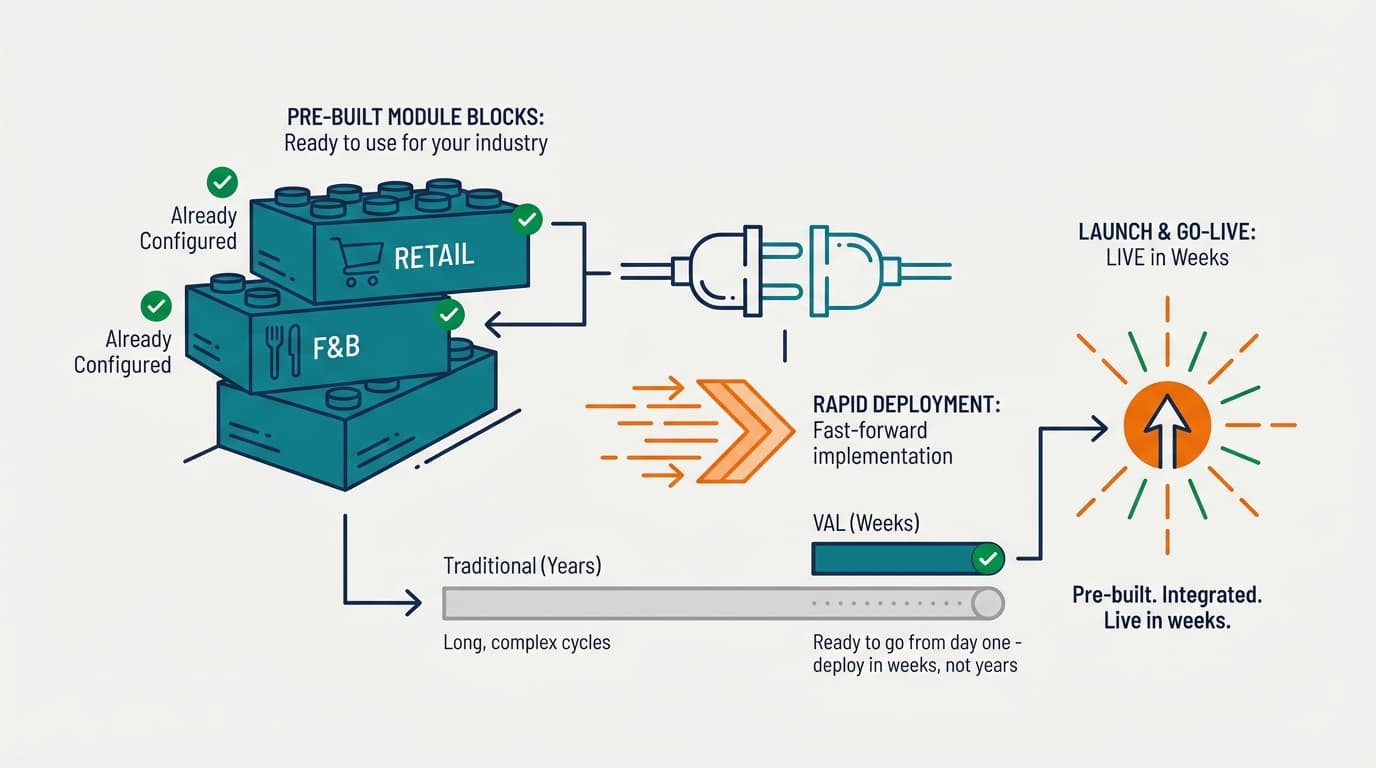
Ready to Go, From Day One
There's a common misconception about automation platforms: that they require months of customization, expensive consultants, and a complete overhaul of how you work. That implementing new technology means disrupting operations, retraining staff, and hoping it all works in the end.
We built VAL to be different. Day-one ready means exactly that: from the moment you start, the platform is configured for your industry, integrated with your systems, and ready to deliver value. Not in six months. Not after a lengthy customization project. Now.
The Traditional Implementation Timeline
Let's be honest about what "implementation" usually looks like for automation platforms:
Month 1-3: Discovery & Planning
- Consultants interview your team
- Requirements documents get written
- System architecture gets designed
- Budget gets revised upward
Month 4-9: Development & Customization
- Custom integrations get built
- Workflows get configured
- Data migration gets planned
- Timeline gets revised backward
Month 10-12: Testing & Training
- Bugs get fixed
- Staff get trained
- Processes get adjusted
- Go-live date gets postponed
Month 13+: Go-Live & Stabilization
- Things break in production
- Workarounds get created
- More training happens
- You finally start getting value
By the time you're operational, your business has changed. Your competitors have moved. And you're already planning the next upgrade.
Why It Takes So Long (Usually)
Traditional automation platforms take months to deploy because they're generic. They're built to serve every industry, which means they're optimized for none. Every deployment is a custom project:
- Integrations need to be built for your specific systems
- Workflows need to be designed for your specific processes
- Data models need to be configured for your specific needs
- Reports need to be created for your specific metrics
It's not the platform's fault—it's the inevitable result of trying to be everything to everyone.
VAL's Industry-First Approach
We made a different choice: go deep in specific industries rather than wide across all industries. VAL is built specifically for F&B, retail, banking, and malls. This focus changes everything.
Pre-Built Workflows
Your industry's common workflows are already configured:
F&B:
- Order orchestration (dine-in, takeout, delivery, aggregators)
- Kitchen display system integration
- Inventory management with recipe costing
- Multi-location menu management
- Supplier ordering and invoice matching
Retail:
- Omnichannel order management
- Inventory sync across locations
- Transfer order automation
- Customer loyalty integration
- E-commerce + in-store unification
Banking:
- Branch operations workflow
- Customer onboarding automation
- Document processing and verification
- Transaction monitoring and alerts
- Cross-channel customer data
Malls:
- Tenant coordination workflows
- Lease management automation
- Maintenance request handling
- Event coordination
- Foot traffic analytics
These aren't generic templates you need to customize. They're production-tested workflows refined through hundreds of deployments.
Pre-Built Integrations
The systems you already use? We already integrate with them:
- 50+ native integrations with POS systems, ERPs, CRMs, payment processors, delivery platforms, accounting software, and communication tools
- Real-time data sync that happens automatically in the background
- Automatic schema mapping that understands how your systems structure data
- Error handling and recovery built into every integration
- Version management so updates to third-party systems don't break your workflows
You don't build integrations. You don't maintain them. You just connect.
Industry-Specific Data Models
Your data is structured the way your industry thinks about it:
- F&B knows about recipes, ingredients, menu items, and modifiers
- Retail knows about SKUs, variants, sizes, colors, and inventory locations
- Banking knows about accounts, transactions, customers, and branches
- Malls know about tenants, leases, common areas, and events
The platform speaks your language from day one. Your team doesn't need to learn a new way of thinking about your business.
The VAL Implementation Timeline
Here's what day-one ready actually looks like:
Week 1: Integration
- Connect your existing systems (30 minutes per system)
- Data starts syncing automatically
- Historical data gets imported
- Team gets access credentials
Week 2: Configuration
- Review pre-built workflows
- Adjust for your specific variations
- Set up user roles and permissions
- Configure notification preferences
Week 3: Training & Testing
- Train staff on VAL interface (2-3 hours)
- Test workflows with real data
- Verify integrations working correctly
- Prepare for go-live
Week 4: Launch
- Switch on automated workflows
- Monitor for first 48 hours
- Adjust as needed
- Start seeing ROI
This isn't a hypothetical timeline. It's what actually happens when the platform is built for your industry from the start.
"But Our Business Is Different"
Every business is unique in important ways. The question is: where should that uniqueness live?
Where you're probably not unique:
- How you integrate with POS systems
- How you track inventory across locations
- How you process customer orders
- How you generate financial reports
- How you manage user permissions
Where you probably are unique:
- Your specific menu structure or product catalog
- Your operational procedures and business rules
- Your branding and customer communication
- Your pricing strategy and promotions
- Your competitive positioning
VAL handles the undifferentiated parts (integration, data management, workflow orchestration) so you can focus on the differentiated parts (your products, your customers, your competitive advantage).
The platform is configurable where configuration matters. And it's opinionated where best practices apply.
Your Competitive Advantage
Here's the paradox: your competitive advantage isn't in building infrastructure. It's in how quickly you can act on opportunities.
When a new sales channel emerges, can you integrate it in days or months? When customer expectations shift, can you adjust workflows immediately or wait for the next release? When you open new locations, can they be operational in weeks or quarters?
Speed is the competitive advantage. And speed comes from having infrastructure that's ready to go.
Working With What You Have
The other thing "day-one ready" means: you don't replace your existing systems. VAL works with what you already have.
Your POS stays. Your ERP stays. Your CRM stays. Your team's familiar tools stay.
VAL sits on top, connecting everything, unifying the data, and enabling automation. You get the benefits of a modern automation platform without the disruption of replacing everything.
This isn't compromise—it's pragmatism. Your existing systems work. They represent significant investment. And most importantly, your team knows how to use them.
VAL makes them work better together.
From Deployment to Value
Traditional platforms measure success by "go-live date." We measure success by "time to value."
Because deployment isn't the goal. Value is the goal.
With VAL:
- Day 1: Systems connected, data flowing
- Week 1: First automated workflows running
- Week 2: Manual processes eliminated
- Week 3: Time saved, errors reduced
- Week 4: ROI visible, team onboard
You don't wait months to see results. You see results while you're still ramping up.
The Bottom Line
Pre-built for your industry. Integrated with your systems. Deployed in weeks, not years.
This is what happens when you build for specific industries instead of generic use cases. When you solve the same problems once, properly, and make the solution available to everyone who needs it.
Your competitive advantage isn't in spending twelve months implementing infrastructure. It's in what you do with that infrastructure once it's running.
We handle the implementation. You focus on the innovation.