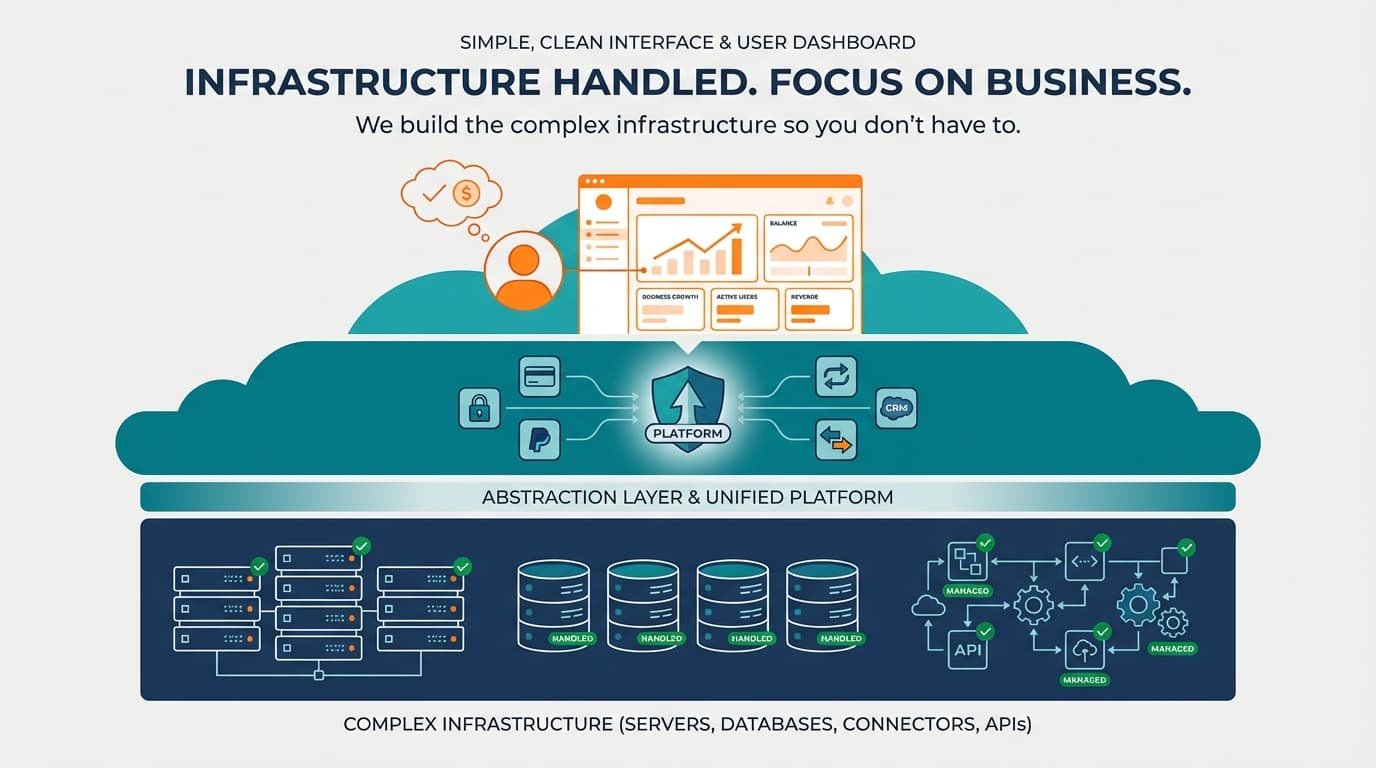
Every business today faces the same fundamental challenge: connecting systems, unifying data, and automating workflows across an increasingly fragmented technology landscape. These are critical capabilities—but they're also undifferentiated. They don't make your business unique. They're just table stakes.
And yet, companies spend months or years building these capabilities from scratch. Engineering teams that could be building competitive advantages instead spend their time wrestling with API integrations, data pipelines, and workflow orchestration. The infrastructure becomes the product, when it should just be the foundation.
The Infrastructure Tax
We call this the "infrastructure tax"—the time, money, and opportunity cost that businesses pay just to make their existing systems work together. It's expensive in obvious ways (engineering salaries, cloud costs, maintenance) and expensive in hidden ways (delayed product launches, missed market opportunities, diverted focus from core business).
The infrastructure tax hits hardest when you're scaling across multiple locations, channels, or systems. What worked for one location doesn't scale to ten. What worked for one channel becomes unmanageable with five. The complexity compounds exponentially.
The Same Problems, Over and Over
Here's what we realized: every business in F&B, retail, banking, and malls faces nearly identical infrastructure challenges:
- Data fragmentation: Sales data in the POS, inventory in the ERP, customer data in the CRM, operations data in spreadsheets
- System integration: Every new tool requires custom integrations that break when anything changes
- Workflow automation: Manual processes that could be automated, but automation requires building and maintaining complex systems
- Multi-location complexity: What works in one location needs to scale to hundreds, each with slight variations
- Channel orchestration: Orders from apps, aggregators, walk-ins, websites—all need to flow through the same backend
These problems are universal. They're hard. They're time-consuming. But they're also solved problems. The solutions exist—they just need to be built once, properly, and made available to everyone who needs them.
Why We Build Once, For Everyone
At ThinkVAL, we made a different choice. Instead of expecting every business to build their own infrastructure, we built it once—production-tested, industry-ready, and designed to work with the systems businesses already use.
This isn't about replacing your existing systems. It's about making them work together seamlessly.
What we've built:
- Pre-built integrations with 50+ systems commonly used in F&B, retail, banking, and malls
- Unified data layer that automatically syncs and normalizes data across all your systems
- Workflow engine that lets you automate processes without writing code
- Multi-location orchestration that handles variations while maintaining consistency
- API infrastructure that makes your data accessible to any tool, now or in the future
All of this has been built once, tested in production across hundreds of locations, and made available as a platform. You don't rebuild it. You don't maintain it. You just use it.
The Opportunity Cost of Building Infrastructure
When you're not building infrastructure, what are you building instead?
- Better customer experiences that differentiate your brand
- Innovative products that open new revenue streams
- Competitive advantages that compound over time
- Domain expertise that becomes your moat
This is where your engineering talent should be focused. This is where your competitive advantage comes from. Not from building yet another data pipeline or integration layer.
Industry-Ready, Not Generic
The key difference between VAL and generic integration platforms: we're built specifically for F&B, retail, banking, and malls. We understand:
- How restaurants handle orders across dine-in, takeout, delivery, and third-party aggregators
- How retail chains manage inventory across locations with transfer orders and central warehouses
- How banks orchestrate workflows across branches, mobile apps, and backend systems
- How malls coordinate with tenants while maintaining centralized operations
This industry focus means the platform comes pre-configured for your workflows. You're not customizing a generic tool—you're using a purpose-built solution that understands your business.
What This Means for Your Business
Week 1-2: Integration
- Connect your existing systems to VAL
- Data starts flowing automatically
- No code changes required
Week 3-4: Automation
- Build your first automated workflows
- Set up alerts and notifications
- Configure dashboards and reports
Month 2+: Innovation
- Focus on business logic, not infrastructure
- Build on top of unified data
- Scale to new locations without rebuilding
The infrastructure becomes invisible. It just works. And your team focuses on what actually differentiates your business.
Built Once, Maintained Forever
Here's the other advantage: when you build infrastructure yourself, you maintain it yourself. Every system update, every API change, every security patch—that's your team's responsibility.
When you use VAL, we maintain the infrastructure. When Shopify updates their API, we update our integration. When a new payment provider launches, we add support. When security vulnerabilities emerge, we patch them. Your systems stay connected, your data stays flowing, and your team stays focused on your business.
The Bottom Line
Data infrastructure and integration are complex, time-consuming, and undifferentiated. Every business needs them. Very few businesses should build them.
We've built what you shouldn't have to build. We maintain what you shouldn't have to maintain. And we keep improving it, so you can keep improving your business.
Your competitive advantage isn't in building infrastructure. It's in what you build on top of infrastructure.
Let us handle the complexity. You focus on what makes you different.